

Product Design Leadership
Bridging Digital & Physical
Evolving the auction experience — bringing physical auctions onto ACV's digital marketplace so buyers, sellers, and on-site staff all work from one connected platform.
The challenge
Two worlds that never spoke to each other.
ACV grew up as a digital wholesale marketplace. Physical auctions — the "RCs" where cars run live through a lane — ran on their own disconnected tools, staff, and rituals. To grow supply we had to make the physical auction a first-class citizen of the digital platform, without breaking the human rhythm that makes a live sale work.
The job wasn't to digitize the auction. It was to connect the physical floor and the digital marketplace into one experience.
Discovery
We started on the auction floor.
Role-based discovery across the live-auction ecosystem — on-site shadowing and interviews to map how each role really works, where the system lags the human, and where signals get lost in the clutter.
Auctioneer
Chant leader and pace-setter — reads the floor vs. online and keeps momentum.
Block Clerk
System operator — bid entry, lights, announcements, and outcome logging.
Seller Rep
Calls SELL / PASS, negotiates reserves, protects the seller's number.
Buyer
Competes for vehicles and needs transparency — on the floor and online.
Research · Discovery
Before we built it, we went and listened.
Two discovery tracks anchored the program — a Buyer Purchase-Path study and a Seller Selling-Path study — pairing dealer and expert interviews with a teardown of how the rest of the industry runs its online lanes. The goal was to understand the real, messy way cars move between the floor and the cloud before designing a single pixel.
How might we give physically-sold cars a digital front door — so more floor inventory reaches our online lanes, and buyers stay engaged all the way through to sell-through?
The purchase path
How a dealer actually buys a car.
We mapped the buyer's journey from first glance to gate pass — five phases, each with its own jobs, tools, and friction. It became the skeleton the buyer experience was built on.
Attention
- Discovery
- Auction registration
Interest
- Run-list review
- Running appraisals
Desire
- Proxy bidding
- Watchlist
- Lane alerts
Action
- Enter sale · handshake
- Simulcast bidding
- Autobid
- Payment
After sale
- Transport
- Post-sale inspection
- Arbitration
- Title · gate pass
What we learned
Five findings that set the brief.
The floor and the cloud are already merging.
Dealers don't bid online as a fallback — they do it to be in many sales at once instead of being trapped at one. Simulcast is how they scale their week.
“I usually attend about 7–10 auctions a week online. I prefer Simulcast — that way I’m not stuck to one auction.”Chris · Independent dealer
But online bidders are second-class on the floor.
Floor bids get priority and proxies almost never win. Worse, remote bidders can’t see who they’re bidding against as the ask price climbs — a real trust and transparency gap.
“Sometimes I lose the car to a floor bidder despite having a higher proxy than the selling price.”Chris · Independent dealer
Every auction is its own island.
Independent auctions each demand a separate “handshake” and registration, run lists live in different tools, and post-sale is handled platform by platform. The friction is the fragmentation.
Simulcast is a tab-juggling act.
The best tools put every lane on one screen with chat, autobid, and alerts. The rest force a new browser tab per lane and drop the very features dealers depend on to move fast.
Selling still runs on Google Docs.
On the sell side, floors, run lists, and pickups are coordinated by text, email, and shared spreadsheets — mission-critical, yet fully manual — with almost no visibility once a vehicle is in motion. The opportunity wasn’t a prettier screen; it was replacing the swivel-chair between a dozen disconnected tools.
Those findings became the brief for everything below — meet dealers where they already are, make the floor legible and fair to a remote bidder, and replace manual coordination with live, connected tools.
The solution
One platform, three connected experiences.
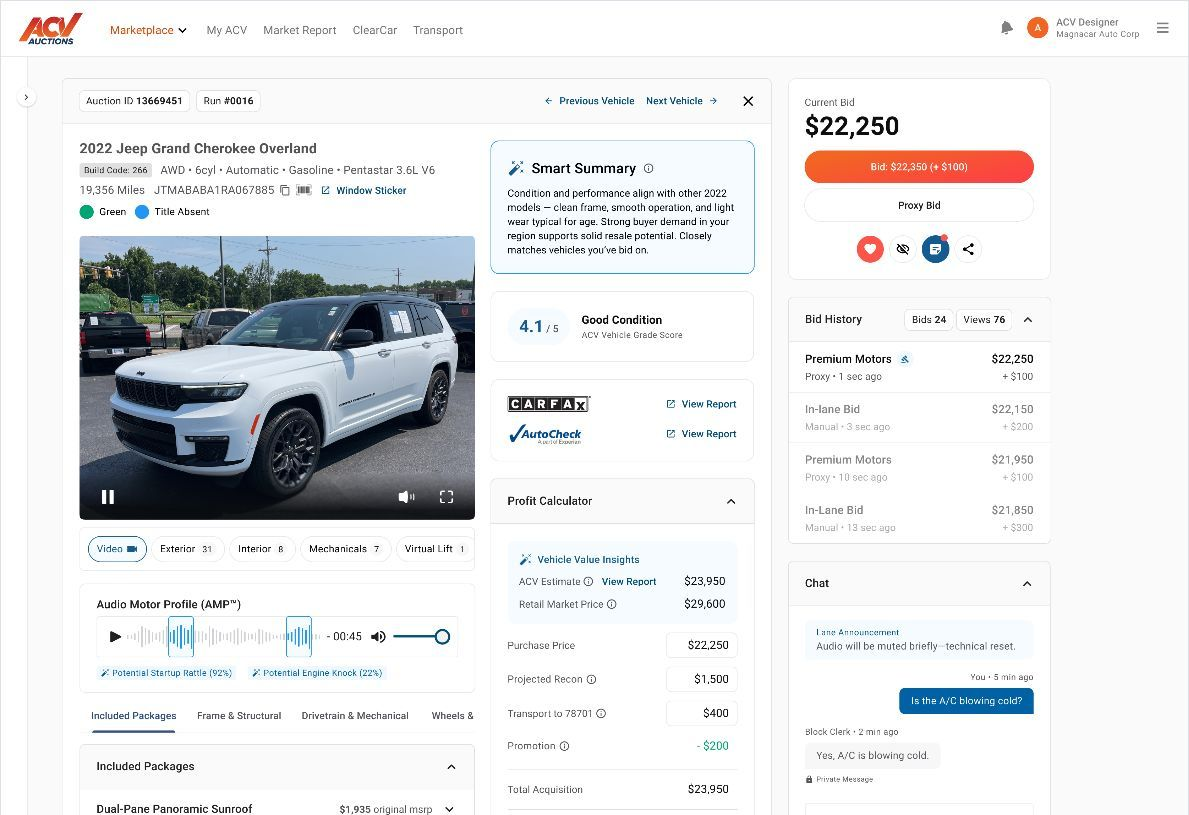
01 · Buyer
Buy from a physical auction — digitally.
- Find live physical-auction events right in search and a new event directory
- A universal VDP with condition reports, announcements, proxy & watchlist
- Simulcast — watch the live lane feed and bid on floor inventory in real time
- Won, checkout, and post-sale management carried through one flow
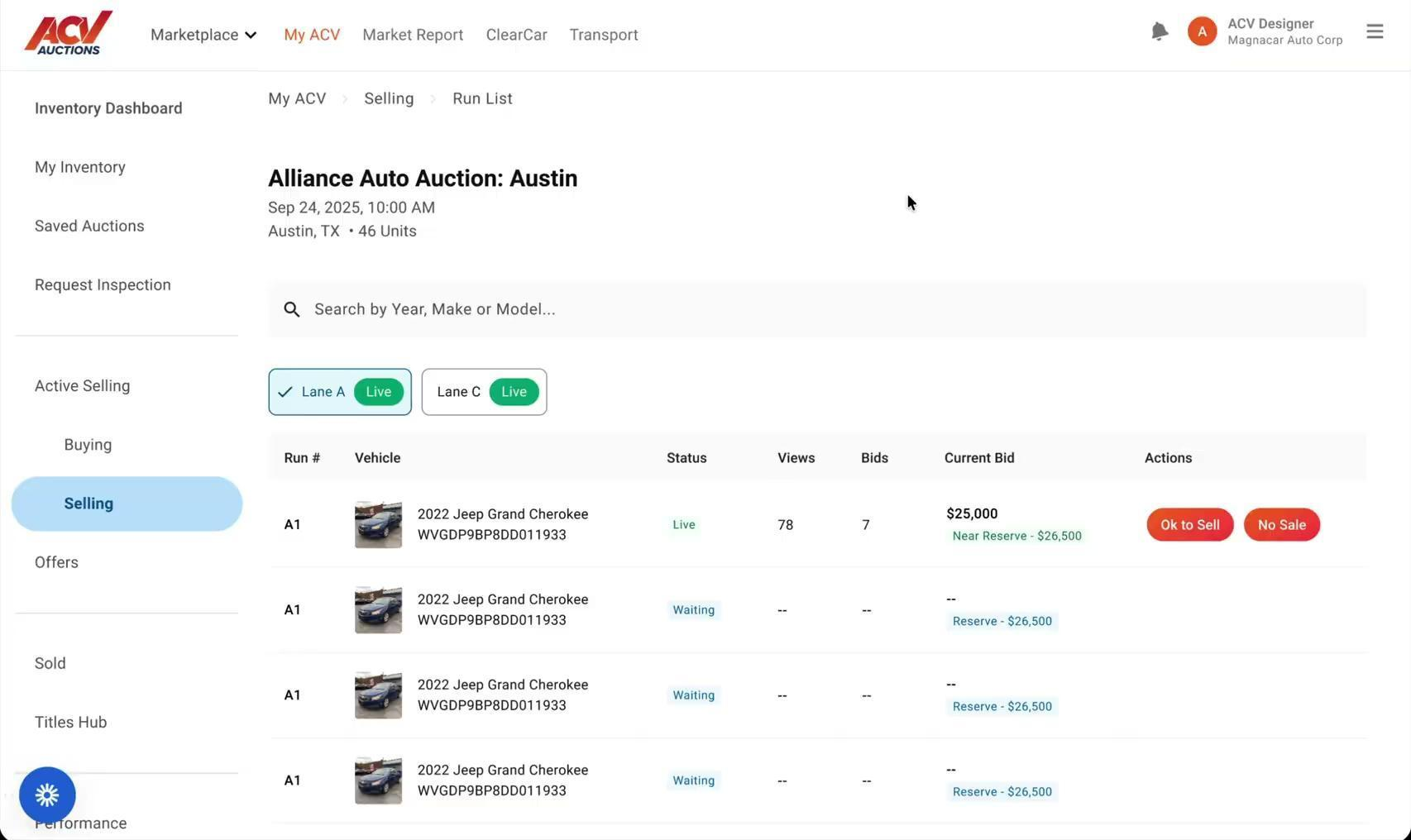
02 · Seller
Run your sale from the lane, in real time.
- My Inventory & Active Selling — see what's ready and what's running
- A new Seller Rep Tool to manage vehicles live: SELL / PASS, reserves, counters
- Live floor + online activity, pricing guidance, and announcements in one view
- Sold, offers, and title handoff connected through the platform
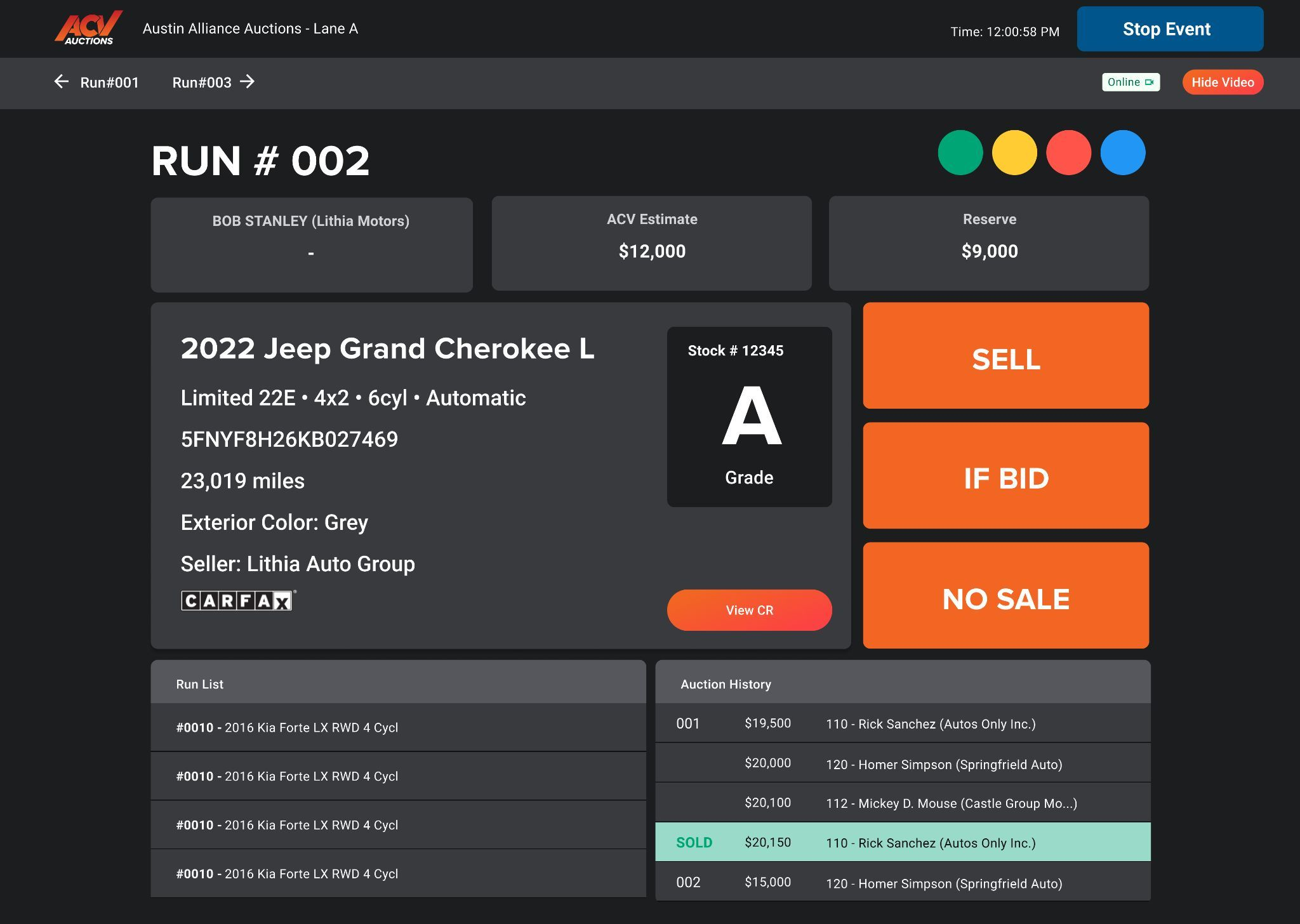
03 · Operations
Run the whole event from one portal.
- An Operations Portal (OAS) — a single home for every internal tool and role
- Net-new tools: Event & Lane management, Block Tool (Clerk + Auctioneer), Wombat reconditioning
- Check-in / check-out, inspections, and bidder badge issuance on-site
- Global navigation and role-based access tying it all together
Service design
One service, mapped end to end.
To make a physical auction run in-house on ACV's tools, I mapped each role's day-of-sale journey — every job-to-be-done tied to the tool that does it — then connected the maps so a hand-off in one journey becomes the trigger for the next. A vehicle checked in by Ops shows up live for the buyer, on the block for the auctioneer, and in the seller's lane view — one continuous flow instead of disconnected systems.
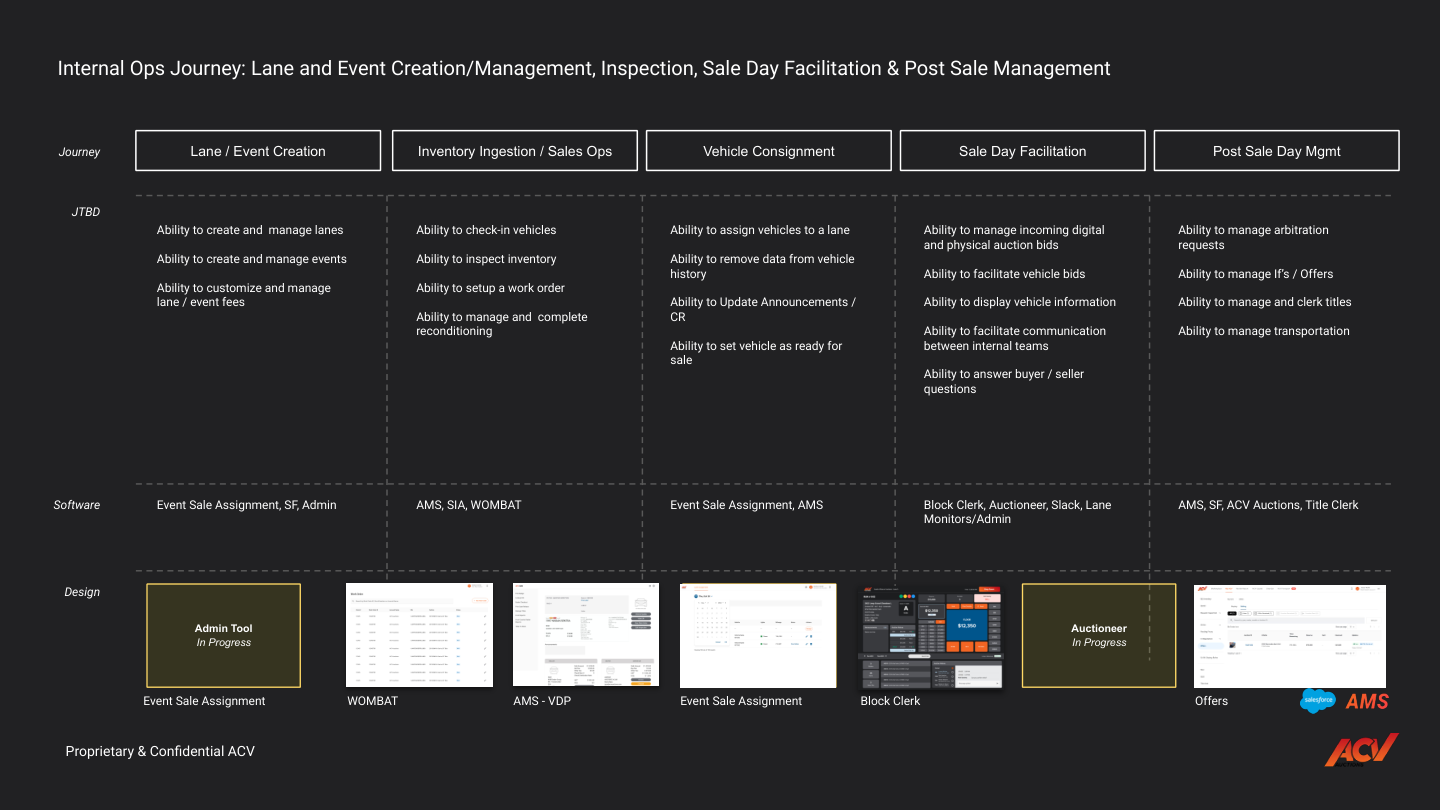
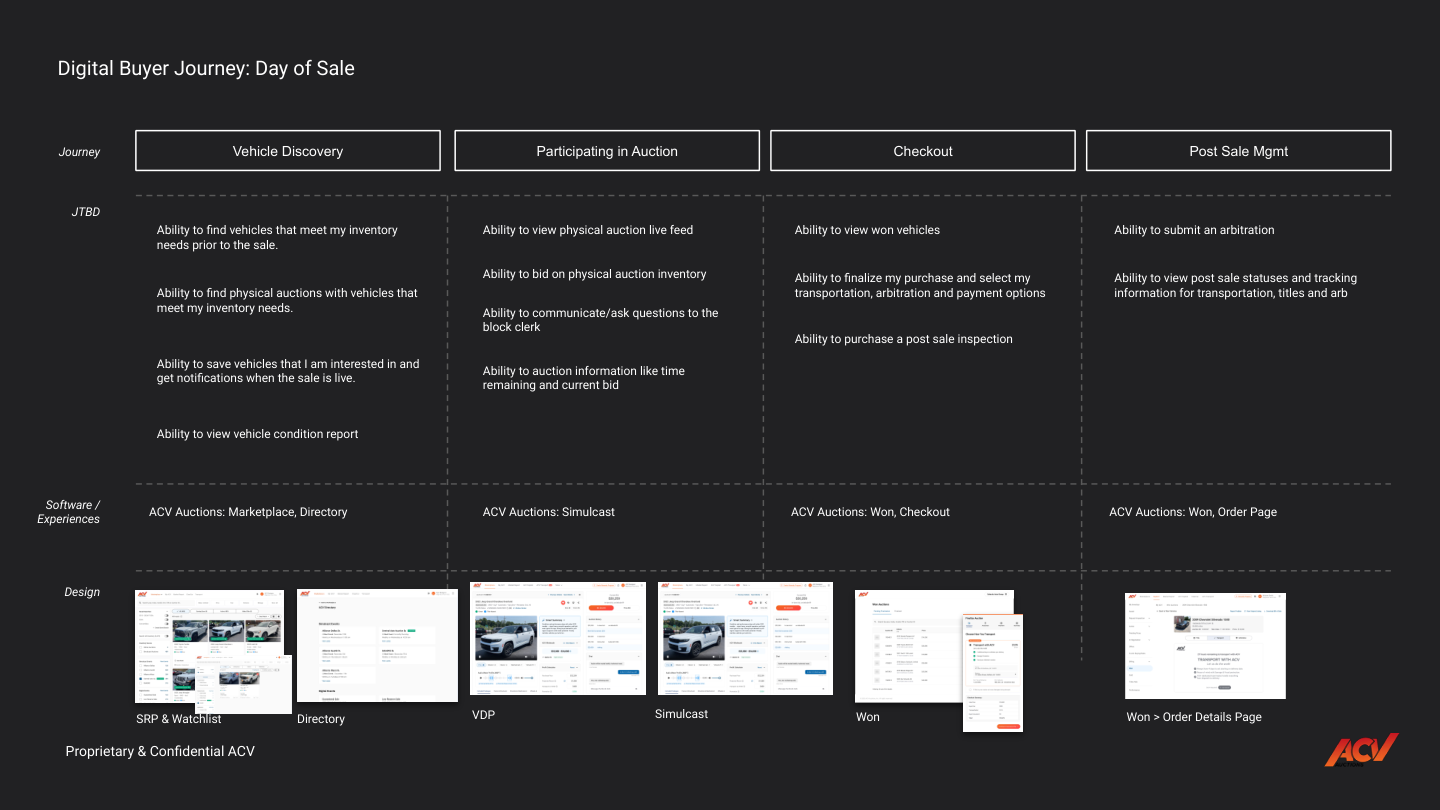
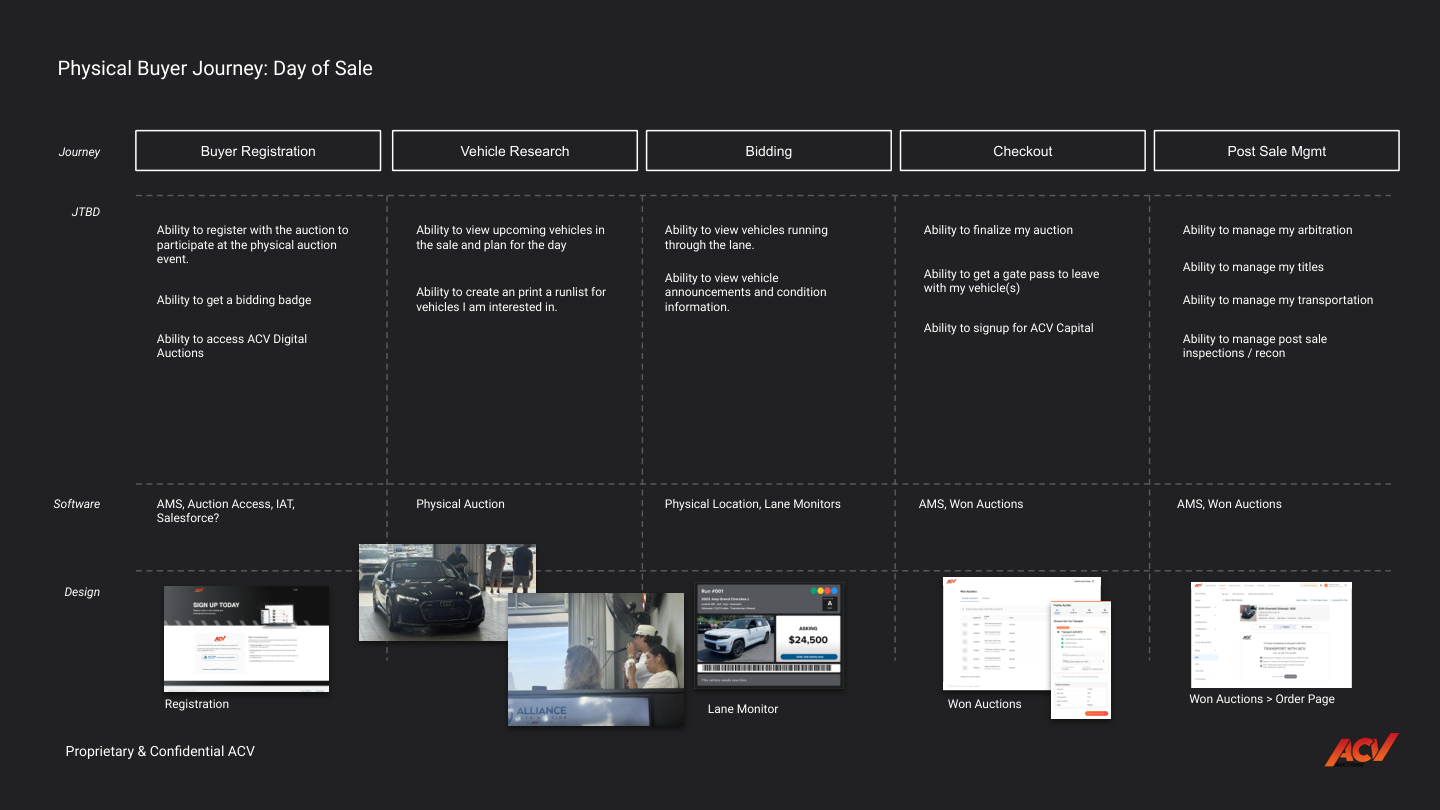
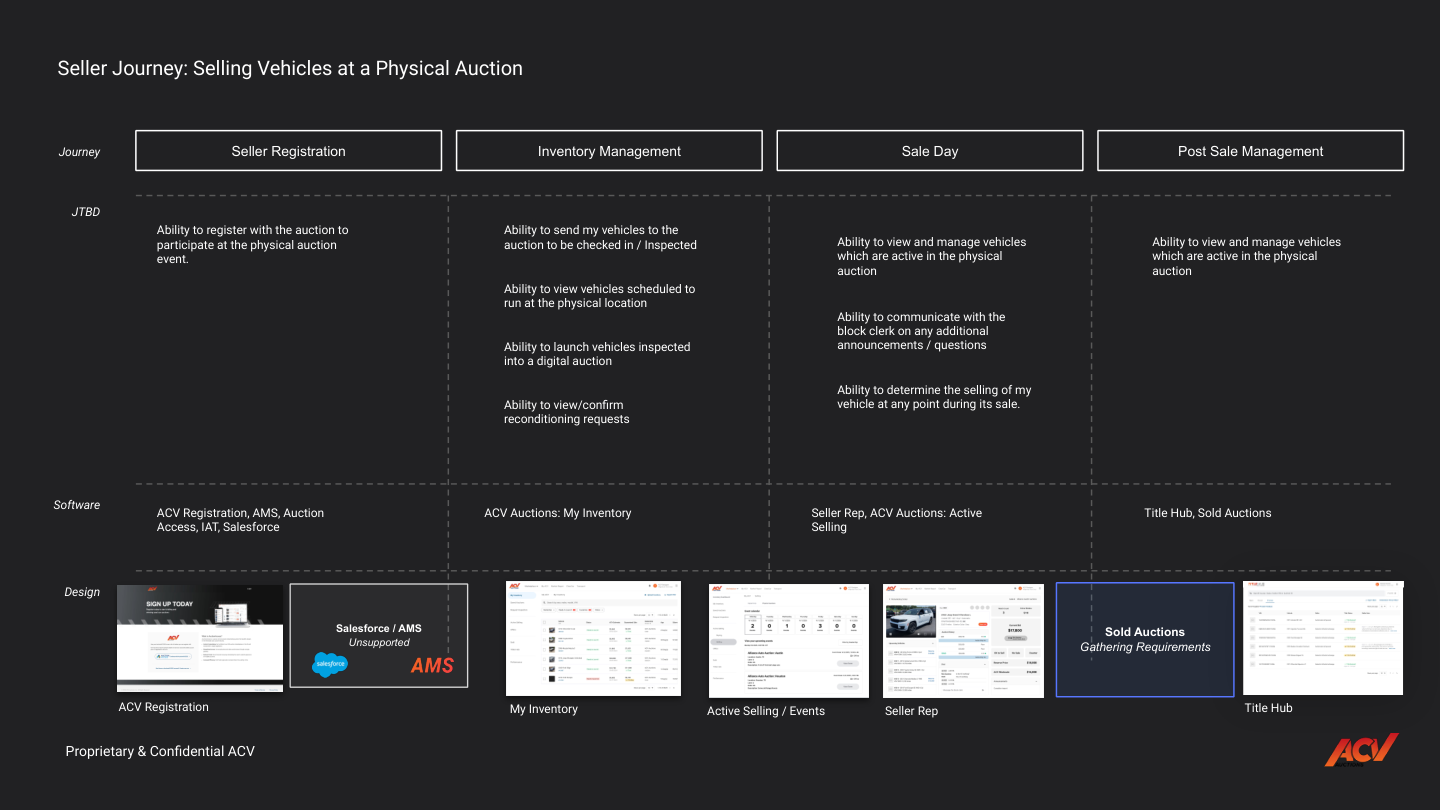
Mapped together, the journeys left no gaps — every hand-off had a home, so the physical auction could run entirely on ACV's stack.
My role
Leading the design program.
- Set the holistic design direction across a dozen-plus connected systems and three audiences
- Managed a team of 8 designers + 1 researcher, aligning each workstream to shared JTBDs and a single readiness roadmap
- Owned the global navigation, Operations Portal entrance, and connected-apps architecture that stitched the tools together
- Drove a competitive analysis vs. industry tools and a continuous usability program to keep validating with real auction staff
- Partnered with product & engineering to sequence an enterprise rollout (AOS readiness) across many teams
The floor and the marketplace, finally in sync.
One connected experience for everyone who touches the sale.