Your dreams,
before they slip away.
Somnar is a voice-first dream journal — fast enough to catch a dream at 3am, and built to turn what recurs across your nights into a genuinely personal, data-driven read on your own symbols.
Try it yourself
The whole thing, running live.
This is the real prototype, embedded right here with premium unlocked — capture a dream by voice or text, watch the symbols extract, then open Patterns and read it through the lenses. Everything stays in your browser.
Voice capture works best in Chrome. Open it full-screen ↗
See it in motion
The real app, running.
Not mockups — these are screen recordings of the working prototype: the first-run tour, capturing a dream entirely by voice, and the pattern layer with lucid mode and cited explanations.
Onboarding
A short, guided tour that sets the tone — calm, gold, unhurried — then gets out of the way.
Talk to save a dream
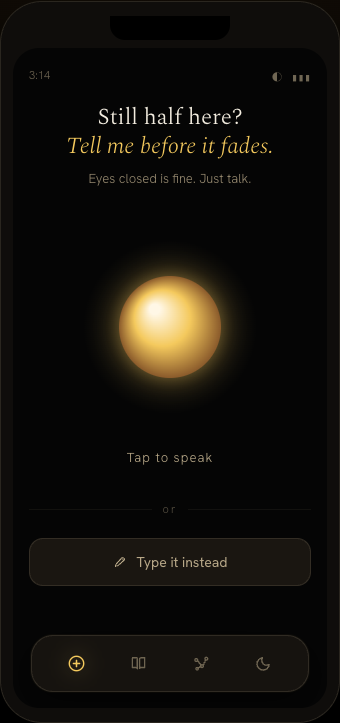
Tap the orb and speak. Voice transcribes in the moment, symbols are pulled, and the dream is saved — eyes never open.
Patterns, lucid & lenses
Recurring symbols, a lucid-mode read, and dream explanations through cited frameworks — your data, made meaningful.
The experience
One calm loop, start to finish.
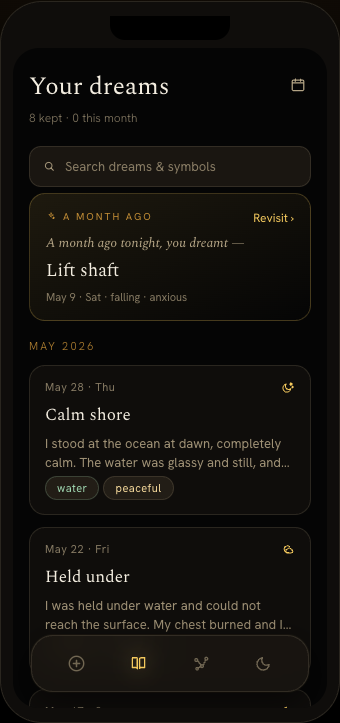
Capture beats everything else — one big mic, voice-first, zero navigation. From there a dream flows into a rich archive, generative art, and a pattern layer that only grows more personal the more you log.
Design principles
A few rules I refused to break.
Capture beats everything
If catching a dream takes more than a breath, it’s already gone. Voice-first, eyes-closed, zero navigation — the capture screen can never get in its own way.
Calm, not clinical
Gold on black, serif, slow light. A dream journal should feel like the hush of 3am — never like a productivity app demanding a streak.
A pattern, never a verdict
Every interpretation is drawn only from your own entries and cites a named framework. No unsourced dream-dictionary claims, ever.
Meaning is earned, and yours
Capture and archive are always free; meaning is the layer that grows. Contributing to the aggregate is off by default — your data, on your terms.
The dream image
Every dream becomes an image.
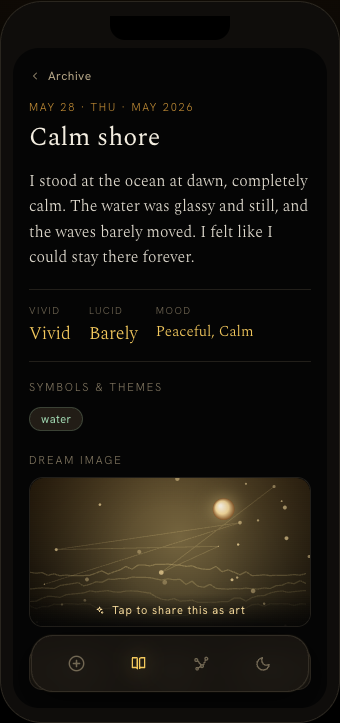
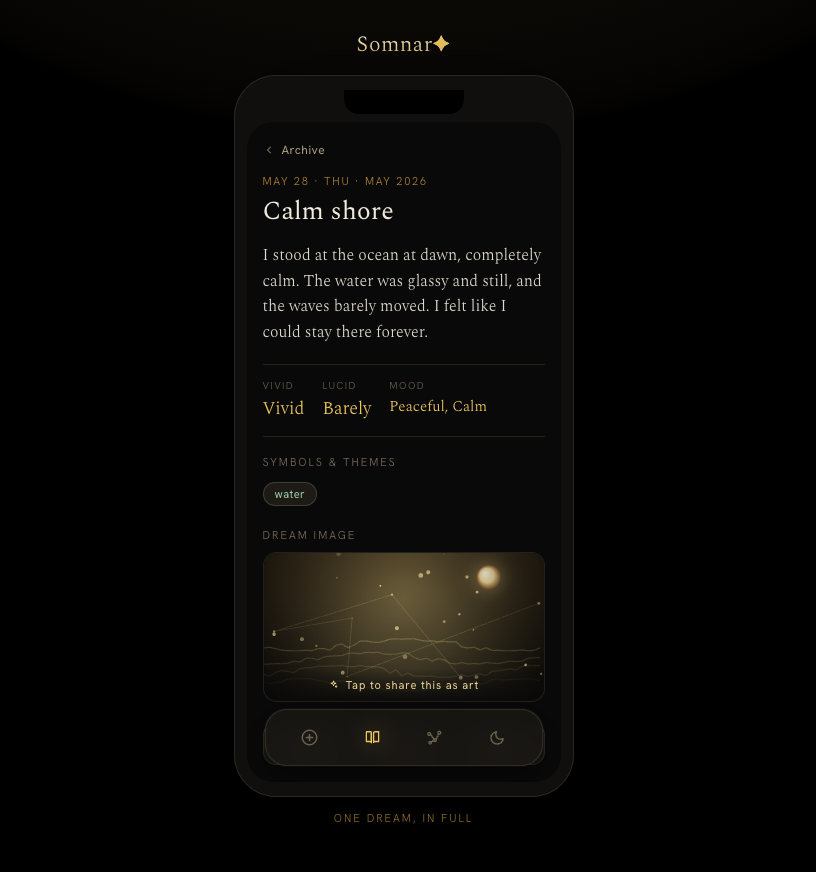
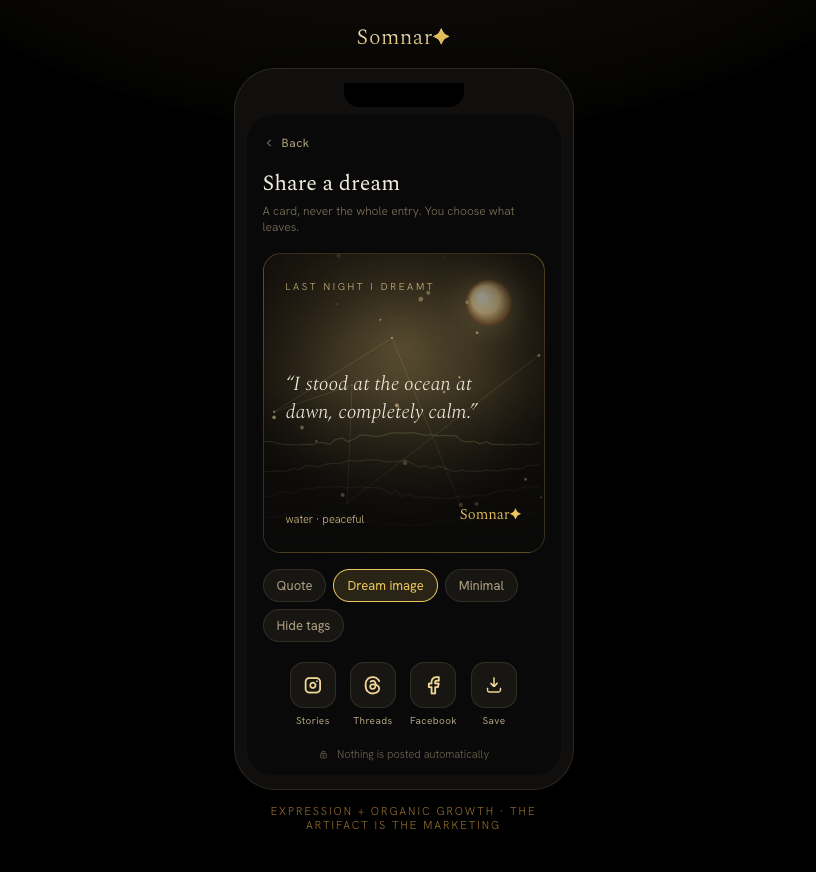
Each entry generates a luminous gold dream-image, tied to its own symbols and mood — and that single artifact is reused throughout Somnar. It’s the dream’s art in the archive, and a share-card you can post without ever revealing the whole entry.
That same gold-on-black language lives in motion, too — a dream-art library I generated in Higgsfield and art-directed into one coherent set, used across onboarding, the listening orb, and the dream imagery throughout the app.
How it works
Capture is free. Meaning is the layer that grows.
The whole core loop runs for real in the prototype — on-device, no backend. Dreams persist locally; symbol extraction stands in for the model; everything is shaped like the production schema.
Capture
One tap, just talk. Voice transcribes in the moment; typing is always a fallback. Nothing to navigate at 3am.
Extract
Symbols and themes are pulled per-mention — the literal phrase, the sentence around it, and how it felt — never a flat boolean.
Echo
When a symbol recurs, Somnar surfaces it gently — celebratory or quietly careful, depending on the dream’s mood.
Patterns
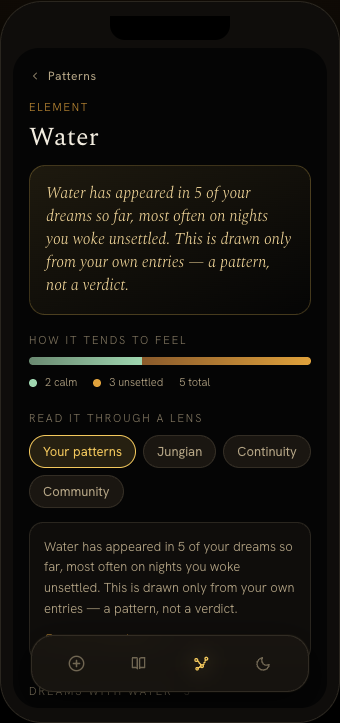
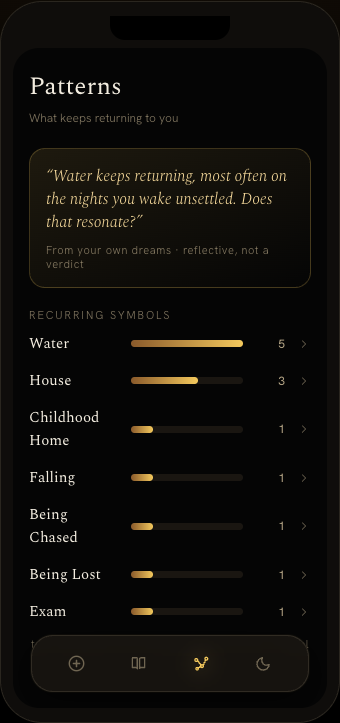
Over time, your own recurring symbols become a personal, cited read — Jungian, continuity, community lenses, never an unsourced verdict.
Echo
“You’ve been here before.”
When a dream’s symbols recur, Somnar surfaces an Echo — a gentle signal that this has happened before. The first recurrence is a single, quiet moment; after that, it tells you how many times, so a returning theme becomes visible instead of slipping away unnoticed.
The data → the meaning
Your tags become your own dream dictionary.
Most dream apps hand you a stranger’s dictionary — “water means emotion.” Somnar does the opposite. Every capture records each symbol per mention: the exact phrase, the sentence around it, and how it felt. Meaning is built from your data, not someone else’s lookup table.
Capture a tag
“Water” is never a checkbox. It’s stored with its surface form, its context, and its valence — every single time it appears.
It accrues
Across nights, those mentions stack: how often a symbol shows up, and how it tends to feel when it does.
A definition forms
“Water, for you, returns most on the nights you wake unsettled.” A personal, evidence-backed read — one only your dreams could have written.
The more you capture, the sharper it gets — a dream dictionary that is genuinely, and only, yours.
Process
Concept to clickable, self-built in two days.
Brand, schema, eight screens, motion, and a working prototype — designed and built solo, with AI tools doing the heavy lifting where they’re strongest.
Figma
Brand board, the gold-on-black system, icon set, and all eight screens — the locked source of truth the build was made from.
Higgsfield
Generated the dream-art motion library, then art-directed it into one consistent, luminous visual language.
Claude
Paired to turn the locked design into a real, on-device prototype — the full capture → patterns loop, running for real.
Catch them before they fade.
Somnar is a small proof that one person, with the right tools and a clear point of view, can take a product from idea to a polished, motion-rich prototype in a weekend.
← Back to all work